Tata Sierra EV Charging Guide: Times, Speeds & Costs
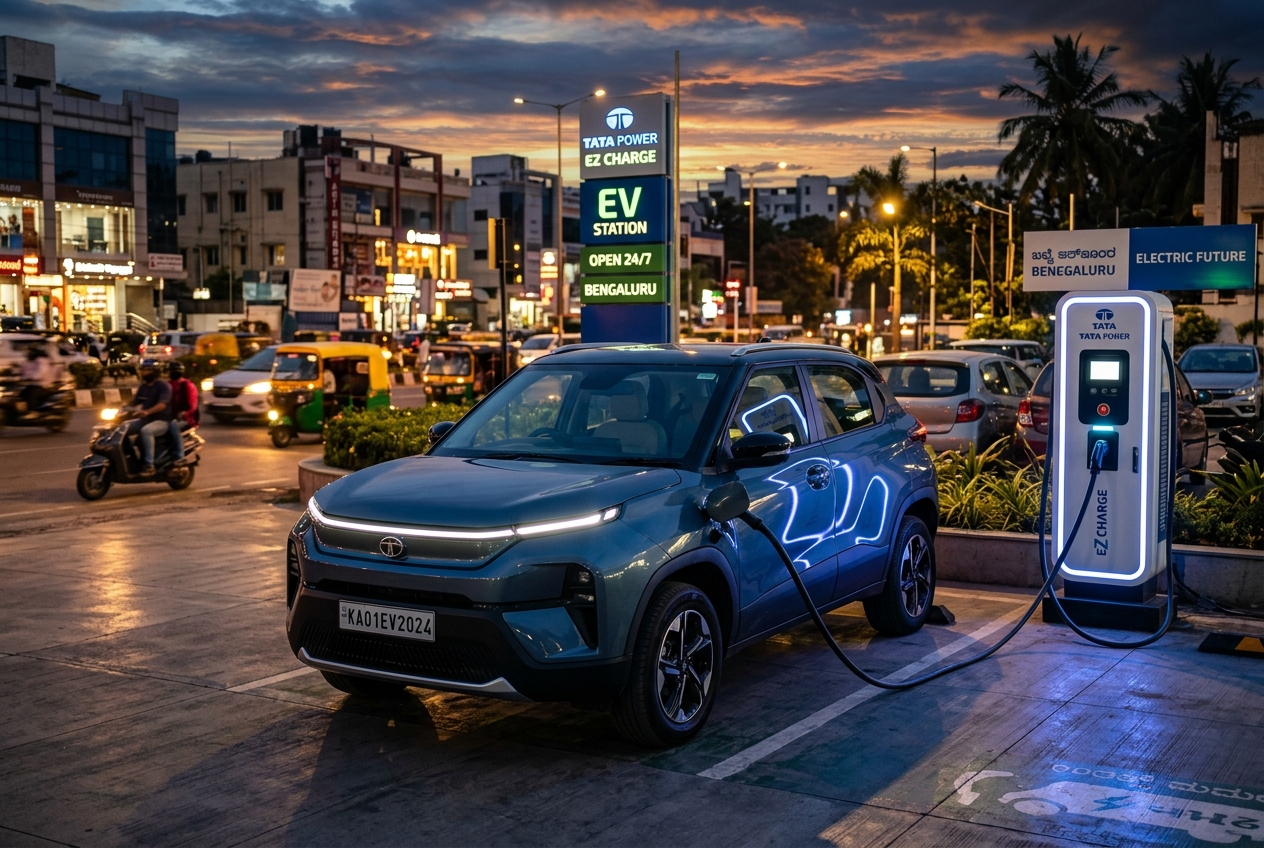
The highly anticipated legendary SUV has returned, completely electrified: the Tata Sierra.ev. Built on Tata’s advanced Acti.EV+ architecture, this retro-modern electric SUV is engineered to handle both rugged Indian terrain and long highway cruising.
If you are planning to purchase or recently booked a Sierra EV, understanding how it charges—and how much it costs—is key to a smooth ownership experience. In this guide, we break down the charging times, speeds, and costs for both the 63 kWh (RWD) and the larger 75 kWh (RWD/AWD) battery pack configurations.
🔋 The Auditorium Analogy: 63 kWh vs. 75 kWh
To visualize how the two battery sizes charge, let’s use the Auditorium Analogy:
- The 63 kWh Battery (RWD): Think of this as a 63-seat auditorium. It takes less time to fill all the seats (fully charge), making it highly efficient. It is paired with a rear-wheel-drive single motor, delivering a claimed MIDC range of 565 km (~450 km real-world).
- The 75 kWh Battery (RWD/AWD): Think of this as a larger 75-seat auditorium. It takes slightly longer to fill up to 100%, but it offers a longer driving range of up to 665 km MIDC (~520 km real-world).
Both models come equipped with an 11 kW AC onboard charger for fast home and public AC charging. When charging on public DC fast chargers, both variants support up to 120 kW DC fast charging input, allowing you to replenish the battery very quickly.
graph TD
    A[Power Grid] --> B(Level 2 AC: 7.2 kW / 11 kW)
    A --> C(Level 3 DC: 120 kW Max)
    B -->|~8.9 Hours| D[63 kWh Battery 10-100%]
    B -->|~10.5 Hours| E[75 kWh Battery 10-100%]
    C -->|~26 Mins| D[63 kWh Battery 20-80%]
    C -->|~26 Mins| E[75 kWh Battery 20-80%]
⚡ Tata Sierra.ev Charging Times Comparison
Below is a side-by-side comparison of charging times for both battery variants. The calculations are based on standard charging efficiency limits (including the vehicle’s 11 kW AC charging limit and 120 kW DC charging limit):
| Charger Type | Output Power | 63 kWh Variant (MIDC: 565 km) | 75 kWh Variant (MIDC: 665 km) |
|---|---|---|---|
| Household Socket (15A) | 2.3 kW AC | ~27.5 hours (10-100%) | ~32.5 hours (10-100%) |
| Single-Phase Home Wallbox | 7.2 kW AC | ~8.9 hours (10-100%) | ~10.5 hours (10-100%) |
| 3-Phase Public AC Charger | 11 kW AC | ~5.7 hours (10-100%) | ~6.8 hours (10-100%) |
| Fast AC Charger (Capped) | 22 kW AC | ~5.7 hours (10-100%)* | ~6.8 hours (10-100%)* |
| DC Rapid Charger | 50 kW DC | ~59 mins (10-80%) | ~70 mins (10-80%) |
| Ultra-Rapid DC Station | 120+ kW DC | ~26 mins (20-80%) | ~26 mins (20-80%) |
[!IMPORTANT]
* The Tata Sierra.ev has a maximum onboard AC charger acceptance rate of 11 kW. If you plug the vehicle into a 22 kW AC charger, the vehicle will cap the speed at 11 kW, meaning it will charge at the same speed as an 11 kW charger.
💰 How Much Does It Cost to Charge a Tata Sierra EV?
The cost to charge your Sierra EV depends on whether you charge at home using residential electricity tariffs or at a public commercial charging station (like TATA Power EZ Charge, Zeon, or Jio-bp).
Here is an estimated cost breakdown for a full charge (0-100%, factoring in 10% grid charging losses):
1. Home Charging Costs (India)
At an average Indian residential electricity rate of ₹8 per unit (kWh):
- 63 kWh Variant: Full charge costs approximately ₹560.
- 75 kWh Variant: Full charge costs approximately ₹667.
2. Public DC Fast Charging Costs (India)
At a typical commercial public DC rate of ₹21 per unit (kWh):
- 63 kWh Variant: Full charge costs approximately ₹1,470.
- 75 kWh Variant: Full charge costs approximately ₹1,750.
[!TIP]
To save money, charge your Sierra EV at home overnight. Many electric utilities in India offer lower Time-of-Day (ToD) tariffs or night-time EV charging rates that can drop your cost to as low as ₹4 per unit, slashing your running costs to under ₹300 per full charge!
📈 Range Added per Hour of Charging
If you are topping up on the go, how much driving range do you actually get back for every hour your Sierra EV is plugged in? Here are real-world estimates:
- Household Socket (2.3 kW): Adds about 13.6 km of range per hour.
- Home Wallbox (7.2 kW): Adds about 44 km of range per hour.
- Public AC Station (11 kW): Adds about 65 km of range per hour.
- DC Rapid Charger (50 kW): Adds about 297 km of range per hour (up to 80%).
[!WARNING]
DC fast charging speeds slow down significantly (taper) after the battery reaches 80% state of charge (SoC). This is a built-in safety feature to prevent the battery from overheating and degrading. On long trips, it is best to unplug at 80% and resume driving, as charging from 80% to 100% can take as long as charging from 10% to 80%.
🏁 The Verdict
The Tata Sierra.ev represents a huge leap forward in terms of charging speeds, supporting a robust 11 kW AC onboard charger and a rapid 120 kW DC capability.
If you primarily drive within city limits, a 7.2 kW home wallbox is the absolute sweet spot. It will easily top up your Sierra EV overnight, giving you a full 450–520 km range every morning for a fraction of the cost of petrol.
To calculate exact charging times and costs based on your starting battery percentage, use our free tools:
- Open the EV Charge Time Calculator to customize your starting and target charge percentages.
- Browse the full Tata Sierra.ev (63kWh) specs page or Tata Sierra.ev (75kWh) specs page to see charging charts.
- Check specifications for other models in the complete EV Database.