Level 1 vs. Level 2 vs. Level 3 EV Charging Guide
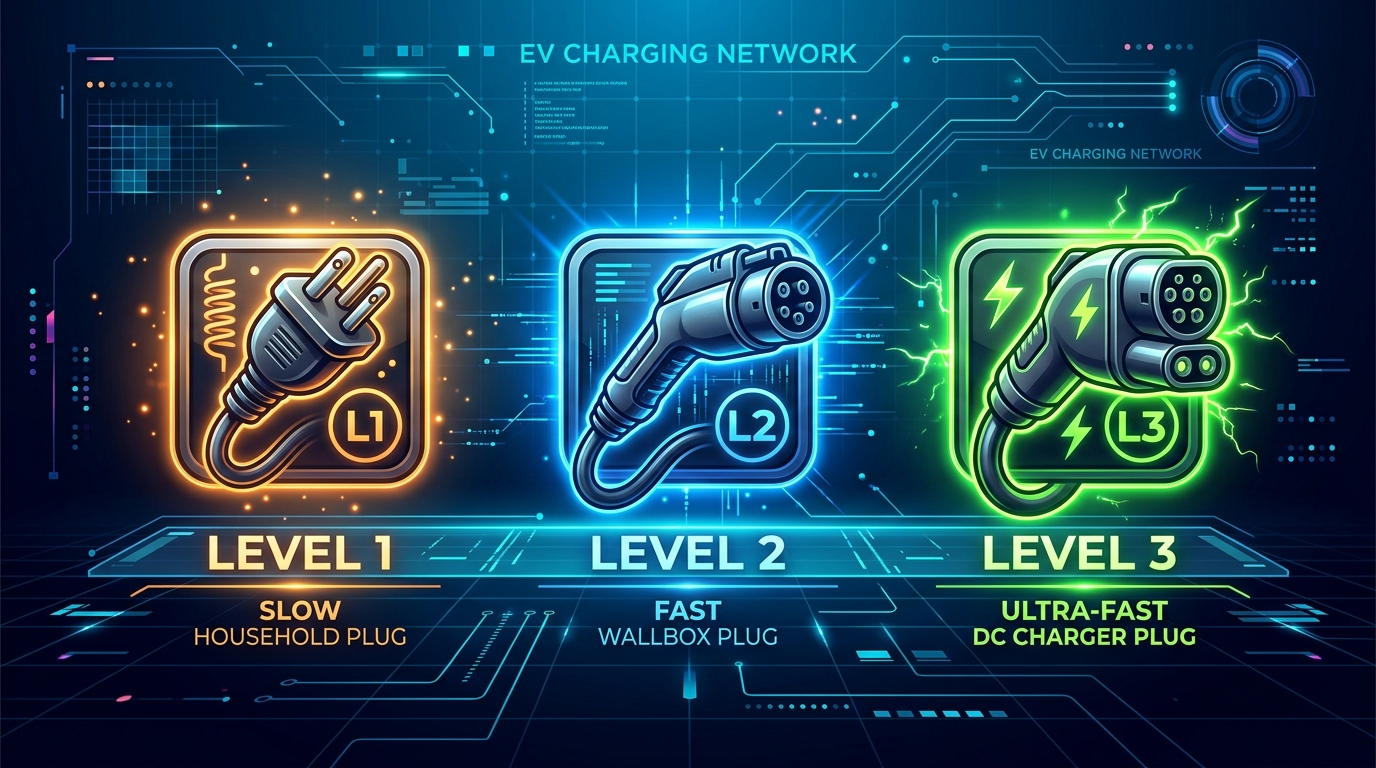
Charging an electric vehicle (EV) is a completely different experience from refueling a petrol or diesel car. Instead of one standard nozzle at a service station, EV charging is divided into three distinct tiers: Level 1, Level 2, and Level 3 (DC Fast Charging).
Understanding the differences between these levels is key to choosing the right charger for your daily commute, road trips, and home installation.
In this guide, we break down how each level works, their charging speeds, installation costs, and when you should use them.
EV Charging Levels Compared: The Basics
| Feature | Level 1 (Slow) | Level 2 (Fast) | Level 3 (DC Fast/Rapid) |
|---|---|---|---|
| Power Source | 120V AC (standard wall plug) | 208V–240V AC (dryer plug/wallbox) | 400V–1000V DC (direct current) |
| Power Output | 1.0 kW to 2.4 kW | 3.6 kW to 22.0 kW | 50 kW to 350+ kW |
| Avg. Speed (Miles/Hr) | 3 – 5 miles of range per hour | 15 – 60 miles of range per hour | 100 – 200+ miles in 15-30 minutes |
| Primary Location | Home, emergency use | Home, workplace, public parking | Motorway service stations, hubs |
| Vehicle Compatibility | All EVs | All EVs | Most EVs (depends on DC port support) |
To see how these different power outputs translate into charging times for your specific vehicle, use our interactive EV Charge Time Calculator.
Level 1 Charging: The Standard Household Plug
Level 1 charging is the simplest way to charge your car. It uses the standard household outlet (120V in North America, 230V in Europe/UK) and the charger cable that typically comes with your vehicle (sometimes called a “granny charger”).
- How it works: You plug one end of the cable into your standard wall outlet and the other into your car.
- Charging Speed: Very slow. It adds about 3 to 5 miles of range per hour. A full charge for a standard EV battery (e.g., 75 kWh) can take 30 to 45 hours.
- Best for:
- Drivers with low daily mileage (under 30 miles per day).
- Plug-in hybrids (PHEVs) with small batteries.
- Emergency situations or overnight stays away from home where no other charger is available.
Level 2 Charging: The Sweet Spot for Home & Work
Level 2 charging is the most common charging method for daily use. It operates on 208V to 240V AC power (the same voltage used by large home appliances like electric clothes dryers or ovens).
- How it works: Level 2 charging requires a dedicated home charging wallbox or a public charger station. You can read reviews of the best options in our Best Home EV Chargers for 2026 Guide.
- Charging Speed: Moderate. It outputs between 7.4 kW and 22 kW, adding 15 to 60 miles of range per hour. A full 10% to 80% charge takes about 4 to 8 hours, making it perfect for overnight charging at home or daytime charging at work.
- Best for:
- Daily EV drivers.
- Overnight charging at home.
- Workplaces, hotels, and public parking garages.
Level 3 Charging: DC Fast Charging & Rapid Charging
Level 3 charging, commonly referred to as DC Fast Charging (DCFC) or Rapid/Ultra-Rapid charging, is the fastest method available. Unlike Level 1 and 2, which supply Alternating Current (AC) that the car’s onboard charger must convert to Direct Current (DC), Level 3 chargers feed high-power DC electricity directly into the battery.
- How it works: The stations are very large and connected directly to the high-voltage electrical grid. The charging cable is thick and heavy, and the connector is larger (CCS, CHAdeMO, or NACS).
- Charging Speed: Ultra-fast. Outputting anywhere from 50 kW to 350 kW, these chargers can add 100 to 200+ miles of range in just 15 to 30 minutes.
- Best for:
- Long-distance road trips.
- Commercial fleets or taxi drivers needing quick top-ups.
- EV owners without access to home charging.
[!NOTE] Level 3 charging speeds slow down significantly after the battery reaches 80% state of charge (SoC). This is to protect the battery from overheating and degradation. On long trips, it is usually most time-efficient to unplug at 80% and resume driving rather than waiting for it to reach 100%.
Which Charging Level is Right for You?
For most EV drivers, the ideal setup is Level 2 charging at home for daily convenience, supplemented by Level 3 DC Fast charging during long-distance road trips.
- If you drive less than 20 miles a day, Level 1 might be enough to get by.
- If you commute regularly, installing a Level 2 wallbox at home is highly recommended.
- Never install a Level 3 charger at home; the equipment costs tens of thousands of pounds/dollars, and standard residential electrical services cannot supply the necessary high-voltage grid connection.
To calculate how long it takes to charge popular models at home or on the road, select a vehicle from our database, such as the Tesla Model Y or Kia Niro EV, or run custom calculations on our homepage.