How Long to Charge an EV at Home? (Complete Guide)
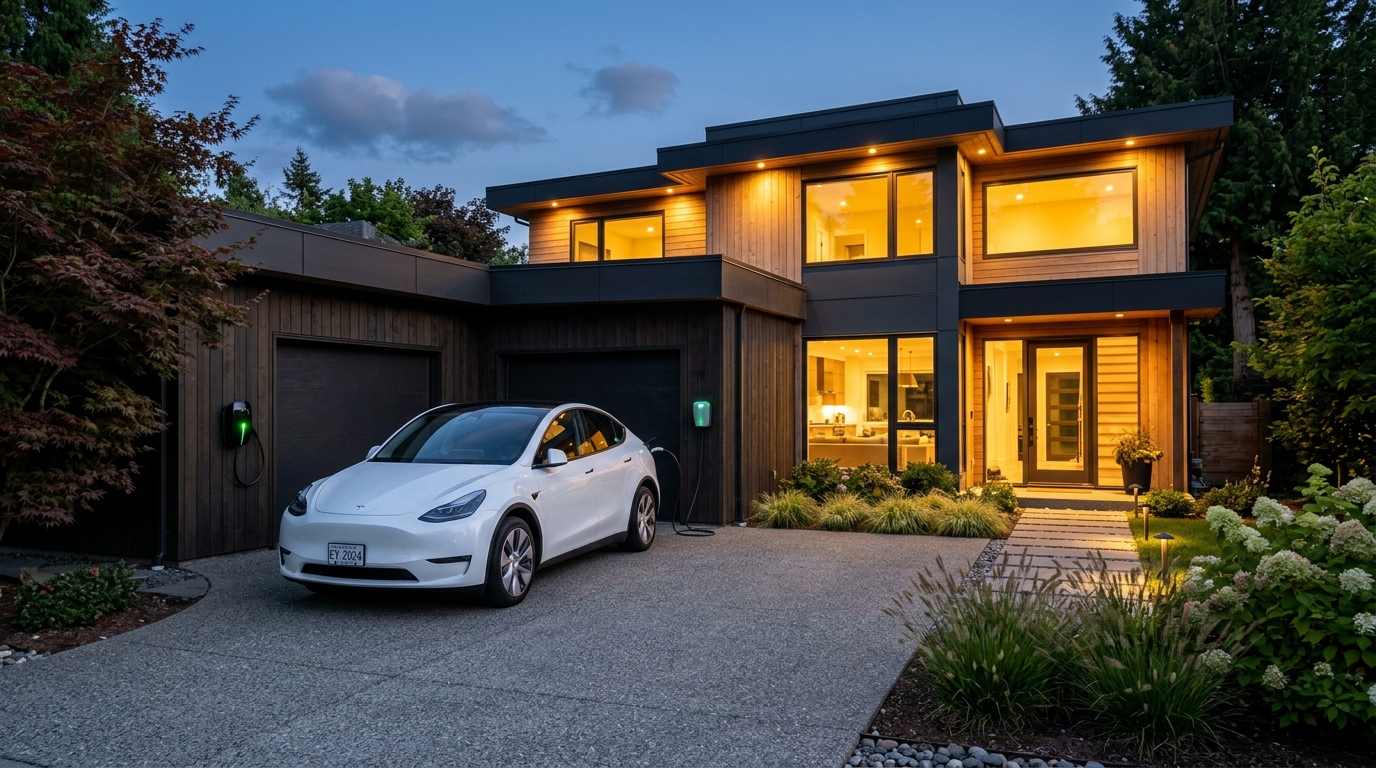
For the vast majority of electric vehicle (EV) owners, home is where the charging happens. It is the most convenient and cost-effective way to power your car. But the first question new or prospective EV owners ask is: “How long does it actually take to charge an EV at home?”
The short answer is: between 4 and 40 hours, depending on your equipment and the size of your car’s battery.
In this guide, we explain the key factors that determine home charging speeds, provide typical charging times for common battery sizes, and teach you how to estimate your own charging speed.
The Home Charging Math: How Speeds Are Calculated
To understand home charging times, you need to understand three simple metrics:
- Battery Capacity (kWh): Think of this as the size of your electric fuel tank. Standard EVs range from 40 kWh (like a Nissan Leaf) to 100+ kWh (like a Tesla Model S or Mercedes-Benz EQS).
- Charger Power (kW): This is the speed at which the charger feeds power into your vehicle.
- Onboard Charger Limit (kW): Every EV has a built-in AC-to-DC converter (the onboard charger). Even if your wallbox outputs 22 kW, if your car’s onboard charger is limited to 7.4 kW, the vehicle will only charge at 7.4 kW.
The Formula
To calculate a rough estimate of your charging time, use this formula:
EV Charging Time
This standard formula calculates the estimated charging duration while accounting for typical AC charging efficiency losses.
(Note: We multiply by 1.1 to account for a typical 10% energy loss due to heat dissipation and conversion inefficiency.)
Want to bypass the math? Use our free EV Charge Time Calculator to get instant, accurate, and pre-calculated estimations for hundreds of EV models.
Home Charging Equipment & Charging Times
Let’s look at how long it takes to charge a standard 75 kWh EV battery (like a Hyundai Ioniq 5 or Tesla Model Y) from 10% to 80% using different home charging setups:
1. The Standard Wall Outlet (Level 1)
- Power Output: ~2.3 kW (10 Amps at 230V) or ~1.4 kW (12 Amps at 120V)
- Charging Time (10% to 80%): ~26 to 41 hours
- Verdict: Too slow for daily use. It is best used as a backup or for plug-in hybrids with very small batteries.
2. Standard Level 2 Home Wallbox (Single-Phase)
- Power Output: 7.4 kW (32 Amps at 230V)
- Charging Time (10% to 80%): ~8 hours
- Verdict: The gold standard. A 7.4 kW charger will fully charge your car overnight while you sleep. You can compare the best home EV chargers for 2026 here.
3. High-Power Level 2 Wallbox (Three-Phase)
- Power Output: 11 kW to 22 kW (requires a three-phase electrical supply, common in parts of Europe but rare in residential UK/US homes)
- Charging Time (10% to 80%): ~2.8 to 5.5 hours
- Verdict: Extremely fast, but installation costs are high because it requires updating your home’s electrical grid service.
Charging Times by Battery Capacity (10% to 80% Charge)
Here is a guide showing typical charging times across different battery classes using a standard 7.4 kW home wallbox:
- Small Batteries (30–50 kWh): e.g., Fiat 500e, Honda e.
- Time to charge: 3 to 5 hours.
- Medium Batteries (50–75 kWh): e.g., Tesla Model 3, Polestar 2, Kia EV6.
- Time to charge: 5.5 to 8 hours.
- Large Batteries (75–100 kWh): e.g., Audi Q8 e-tron, Porsche Taycan, Tesla Model X.
- Time to charge: 8.5 to 11 hours.
- Massive Batteries (100+ kWh): e.g., Hummer EV, BMW i7.
- Time to charge: 11+ hours (may require multiple nights or a higher power charger).
Tips to Optimise Your Home Charging Speed
To get the most out of your home charging setup, follow these best practices:
- Schedule for Off-Peak Hours: Many utility companies offer discounted rates during the night (e.g., midnight to 5 AM). Use your charger’s app to schedule your charging during these hours.
- Charge to 80% for Daily Commutes: Lithium-ion batteries degrade faster if they are kept at 100% charge. For daily driving, set your car’s charging limit to 80%. Only charge to 100% when you are preparing for a long trip.
- Precondition Your Battery: If your car supports it, use the vehicle’s app to warm or cool the battery before charging. This helps the battery accept power at the maximum rate immediately.
To learn more about charging speeds and how home charging compares to public networks, read our complete guide on Level 1 vs. Level 2 vs. Level 3 Charging.